Friday, April 11, 2014

Why do I event?

Last weekend, the eventing community experienced the tragedy of losing 2 horses who were competing at The Fork horse trials. One died following stadium jumping, the other following cross country.

Tragedy of this nature stirs up lots of conversation, especially regarding safety. I am selective with the type of media I engage with on topics like this, but one particularly good post is Me Asking Why by Lauren of She Moved to Texas. Its honest and the comments are (mostly) respectful and thought-provoking. And while it touches on numerous points, I came away from the article asking myself: why do I choose to do eventing (versus another discipline) given the inherent safety concerns with cross-country?

Firstly, I acknowledge that I have the distinct impression that there is increased danger at the higher levels of eventing.  I do not know if that is statistically true, but it's the overall impression I've gotten since I joined the eventing community 5 years ago. And its a large part of why I do not have the ambition to compete at the higher levels. By extension, I feel that the lower levels have a much lower degree of risk, and I take measures to be as safe as possible. I'm fine with BN for now and see myself going Novice one day, maybe Training (maybe not).

Furthermore, while solid fences seem inherently more dangerous, in some respects they are safer. On the one hand, they don't fall down if you crash into them. On the other hand, they're designed to support the weight of a horse, so they don't break or collapse when a horse jumps ON a fence (banks it) rather than OVER it. Horses can get themselves out of trouble with solid fences in ways they cant with stadium jumps. Additionally, it has been argued that horses can better read solid jumps than they do stadium jumps, in the way that horses are generally better over quarter-rounds than they are with oxers. The shapes lend themselves to the task from the horse's perspective. Especially at the lower levels, lots of XC jumps are logs or have roll-tops, and are designed to be very inviting to horses.  In fact, my horse does better with XC fences than with stadium fences. He reads them easier. Or he likes them. Whatever the case, he's a better, safer horse out in XC than he is in the stadium ring.


Galloping in an open field is a huge draw for me. Its simply exhilarating. And eventing is the only sport that includes it (with the exception of hunter paces, which I'd love to try sometime, but also includes solid jumps). Would I get enjoyment if we galloped along and then came to a stadium jump out in the field? Yes. And in fact most schooling derbies have just that. Its just not part of registered events.


Besides the wind-in-the-hair component, another reason I do this sport is that I understand the rules better in Eventing than any other sport that involves jumping, namely hunter/jumpers. Understanding the rules and the scoring makes me feel more empowered with personal improvement, so I get more satisfaction from eventing competitions than I have from hunter/jumper competitions.

So that, in a nutshell, is why I chose to event even in the face of tragedies at the higher levels of the sport.  Thanks to Lauren for the thoughtful post, and for inspiring me to take a good honest look at why I choose this sport.

Tuesday, April 8, 2014

FCHP XC School

On Saturday we headed up to Fresno County Horse Park (formerly Ram Tap) for an XC school. We're doing the HT there at the end of the month.

The weather was perfect, which is highly unusual for Fresno. Our group was: myself on Hemie, TK on George, our trainer Laurie, and her friend Deb (who graciously took photos). 

This facility has a lot of personality. It has a giant electrical processing plant with huge power lines and towers. There's also a gun shooting range at the property - with gunshots echoing throughout the trailer parking area. Plus there's a railroad track running along the fence, with trains passing by regularly. 

None of that bothered Hemie. He was calm as a cucumber. Until...a limping dog waddled into view. 

It took us a few moments to figure out what Hemie was looking at, getting all nervous and snorty. Finally we realized it was an older Labrador cruising around the trailer parking area who was clearly lame - it's uneven gait bothered Hemie, which is very interesting (he's great with dogs otherwise). This is only the 2nd thing we've been able to identify that Hemie finds spooky (the first one being infants - which I agree can be scary). 


For warm up Laurie had us cruise around the whole cross country area, trotting and cantering, checking things out. Hemie and George were good trotting out together, then going their separate ways, then regrouping, then leaving each other. So glad my horse isn't herd-bound, and enjoys going off to explore.

Then we met up at the start box to do our first set of fences together.

Heading to our first jump: Intro coop.
For non-eventers, these photos are a great visual of jump size differences by level. From easiest to most difficult, the levels shown here are:
  1. Intro (not a recognized level by USEA)
  2. Beginner Novice
  3. Novice
  4. Training
  5. Preliminary

Jump levels from Left to Right:
Training, Beginner Novice, Intro, Novice, Prelim. 

You can see that the jumps get bigger and wider with each level. The first few jumps out of the start box tend to be straightforward jumps on flat terrain (such as these) but generally speaking what makes each level more challenging is not so much the height or spread of the jumps - it's "the question" you're being asked to tackle, which generally relates to how the jump is situated. Is it after a sharp turn after a long gallop stretch? Is it on top of a hill? Or on the hillside itself? Is it just a few strides after another jump? Is it located in the middle of a pond? All of these elements make a jump more or less of a challenging question.

Now the BN

We encountered a problem at the 2nd row of jumps: coming to the BN jump, Hemie refused and dodged right.

Uh oh!

We corrected it immediately, but it was a wake up call that I needed to:
  • Be more present
  • Give a more positive ride by channeling "we are doing this!" vibes
  • Have a stronger, more forward canter
  • Add leg when I feel him back off

Intro

BN


BN

I'm proud to report that I worked on all those things throughout the schooling, and overall feel good about my riding. We had a few hiccups, but I was able to identify the issue and correct them right away. I'm very proud of Hemie - he was completely game and a good boy. He really, really, really enjoys XC. And riding a horse doing the thing that he really loves is a wonderful feeling.

Intro


BN
We also did the green N house in the background.


We stuck together as a group for the first few sets of jumps, but then Hemie and I struck out on our own while Laurie and Deb stayed with TK (who is moving up to Prelim at the show), though we generally stayed within visual contact.

BN

These next 3 photos really expose my lower leg issue:

Leg is ON, good placement.

Uh...leg? Why did you go back there?

Leg okay now. 
I really need to keep working on that! Helpful to see that the issue really is over the jumps, not so much before or after.

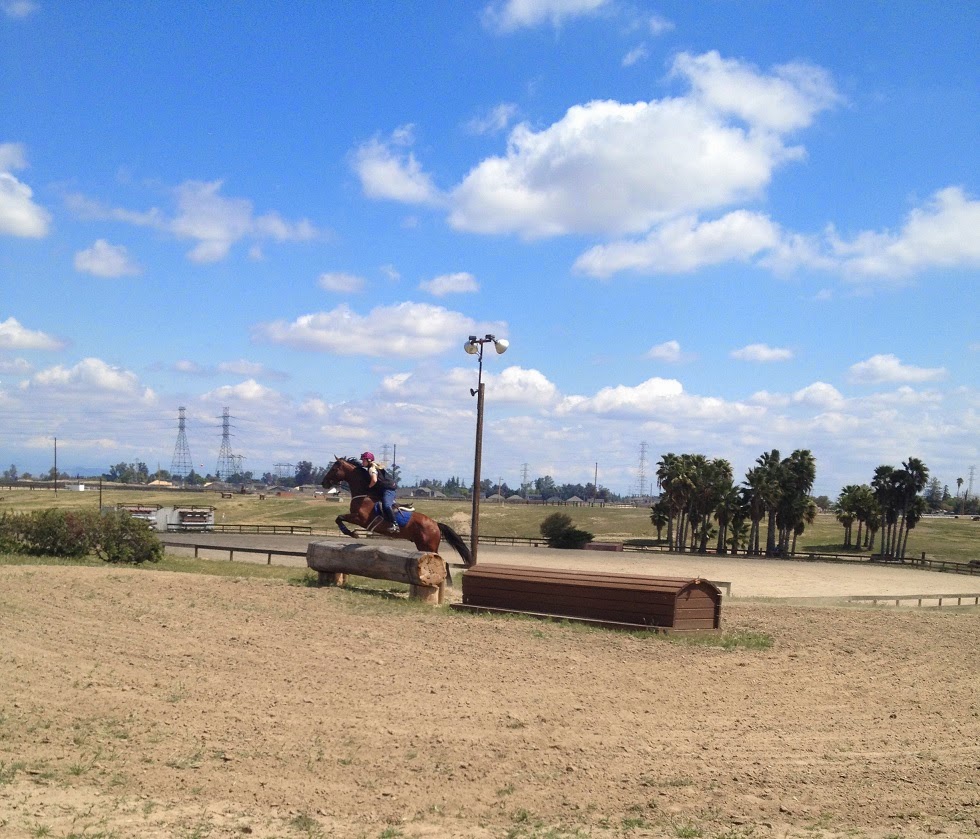
I'm going over Novice house, with TK and George looking on.

We started off doing mostly Intro and BN height jumps, but then graduated to larger stuff too. At the end of the day we did all of the BN and Novice jumps, with a handful of the Intro, and a handful of Training jumps too!


Training Chevron!

It's important to note that the Training jumps I did were very approachable jumps on flat terrain where the only challenge was the increased height.


We did water a few times, but unfortunately there were no banks or ditches! Luckily we have those at home to school (and Hemie has never had issues with them).

Overall it was a fabulous outing. Successful enough to be a real confidence boost, but educational enough that I think I'm a better rider after that experience. 

All smiles

So proud


Friday, April 4, 2014

On Moving Up

Pony hiding in a pepper tree!

First of all, my entries are in and hotel is booked for the Fresno County Horse Park event at the end of the month!  We're headed up there tomorrow to do an XC schooling and I'm pumped!

Plus I'll be picking up my Micklem bridle tonight and am looking forward to trying it. It's a good week in horse-land.

So, on to a fun topic: moving up a level.

There's a lot of great articles about how to know when you're ready to move up. In fact, Denny Emerson wrote an article on it, as did Jimmy Wofford. And there's a few Evention TV videos on it too.  I'm sure there are similar articles out there by pros for other disciplines as well.

I love this topic because there are so many different reasons that people have for moving up (or not). I hope you'll share your thoughts in the comments!!

Some of the schools of thought I've heard of or read are:
  • If you have to ask, that means you're not ready.
  • Move up when you're bored at your level.
  • You should be in the ribbons regularly at your level before moving up.
  • You should already be schooling one level above, and it should be going peachy.
  • Move up every season, unless there's some sort of major issue.
  • Move up as soon as you know how to do the movements for that level.
  • Don't let fear or other people hamper your competition goals - move up as soon as you can.
  • Move up when your trainer tells you to.

I've been asked a few times lately if I have plans to move up, which is what prompted this post. The answer is: not anytime soon. We are currently competing Beginner Novice, and I think we need a few more successful shows before I'd want to move us up to Novice. I'm in no rush. Hemie and I are having fun and still have plenty to learn at our level.

Since I can only afford to do about 3 horse trials a year, right now I foresee us competing at BN for the rest of this year, possibly into next year, before moving up to Novice. Our XC is solid and I think we could do a Novice course just fine (though I'd have to ride consciously to make the time). Stadium would be iffy - we would get through it but I'd rather have a few more double-clean rounds at BN first. And Dressage is still a major work in progress, so if I care about being competitive (which sometimes I do but typically I don't) then it would be prudent to wait until we have a better handle on that.

The factors that are most important to me in deciding when to move up:
  • Safety
  • Confidence
  • Trainer's opinion
Would love to know how other people decide!  Please share your approach!


Wednesday, April 2, 2014

Rolex Preview ~ California Riders

The Rolex Kentucy 3-Day Event is the most well-known eventing competition in the US and is the only 4-star (highest level there is) eventing competition in the western hemisphere. Competitors come from all over the world, and this year there's a total of 81 entrants.

Like a boss.
2013 Rolex Winners
Andrew Nicholson & Quimbo
Photo from COTH

Last year we had 3 riders from California (see my 2013 Rolex CA Rider preview post here, and recap post here) and this year we have all 3 returning, plus 5 more, for a total of 8 (yes, eight!) riders from California!! 


Photo from USEA

Deborah Rosen

From Calabasas, CA

Debbie operates Wild Ride Eventers in Somis, just 20 minutes away from me! This will be Deb and her horse Al (The Alchemyst)'s 5th trip to Rolex together. Al is a big Canadian-bred chestnut gelding, with breed listed as Sport Horse (does that mean Canadian warmblood?). I had the pleasure to audit a clinic of hers last year, and hope to clinic with her this season. Debbie is known for her amazing smile during all her rides - seriously, she looks absolutely blissful headed down to those giant jumps! She is certainly a favorite of mine.


Weeeee!
Photo from Facebook

Bunnie Sexton

From Santa Ynez, CA

Bunnie is another favorite. She operates Shepherd Ranch Eventing in Santa Ynez. This will be her and Ecko (Rise Against)'s first trip to Rolex and their first 4-star event!  Ecko is a beautiful bay thoroughbred. Check out this EN article about them. Bunnie, who is fabulous in her 50s, is proof that you can reach the highest levels of the sport even after you think you've passed your prime competitive years! She is such an inspiration. I've met her a few times, and she is very welcoming and extremely humble.


Through the famous London Olympics horseshoe jump.
Photo from Eventing Nation

Tiana Coudray

From Ojai, CA 

Tiana is currently based in England, but hails originally from Ojai which is about 25 minutes away from me. Finn (Ringwood Magister) is a gray Irish sport horse gelding. Tiana and Finn represented the US at the 2012 Olympic Games, and have a number of international competitions under their belt, though this will be just their 2nd time competing at Rolex. I've met Tiana only once, but she struck me as a very nice and hard working gal.


Photo from Eventing Nation

Jolie Wentworth

From Martinez, CA
USEA Rider Profile
Facebook Page
Kismet Farms

This will be Jolie's 3rd trip to Rolex, and 2nd time there aboard Ari (GoodKnight), a bay Selle Francais gelding. They won the 2012 Rebecca Broussard Endowment Grant and used it to compete at the Luhmuhlen 4-star event in Germany last year. I haven't met Jolie personally but she sure is an elegant rider, and I've heard nothing but compliments from friends who've ridden with her and Tracy at Kismet Farms.


Photo from Facebook

Jennifer McFall

From Wilton, CA
USEA Rider Profile
Facebook Page
Dragonfire Farms

This will be Jennifer and Billy (High Times)'s first trip to Rolex and first 4-star competition together. Billy is a stunning black Holsteiner gelding. Jen and her husband Earl operate Dragonfire Farms, which has always piqued my interest as they breed Morgans in addition to doing eventing training and riding.


And our returning riders from 2013 Rolex...

Little horse. Big jump. No problem.
Photo from Facebook

Hawley Bennett-Awad

From Temecula, CA
USEA Rider Profile
Facebook Page
Hawley Bennett Eventing

Hawley is probably the most famous California rider, though she represents Canada at international competitions. She operates Hawley Bennett Eventing out of Kingsway Farm in Temecula. She and Ginny (Gin & Juice) are headed to Rolex for the 3rd time together - last year they placed 7th! They've done quite a bit of international competition - in fact, this is their 7th 4-star event! I had the privilege to clinic with Hawley earlier this year, and I've watched them compete numerous times. Ginny is an adorable bay Thoroughbred mare. Hawley lovingly refers to Ginny as her "pocket rocket" because she is small (15.3) but go-go-go!


Photo from USEA

Kristi Nunnink

From Auburn, CA
USEA Rider Profile
Facebook Page

Kristi operates Kristi Nunnink Eventing out of Next Star Farm in Auburn, CA. This will be her and her horse Rosie (R-Star)'s 5th time at Rolex - last year they placed 8th! Rosie is a beautiful gray Holsteiner mare. They competed at Pau, France last year and are constantly in the top placings at West Coast events.


Photo from USEA

James Alliston

From Castro Valley, CA
USEA Rider Profile
Facebook Page
James Alliston Eventing 

James operates James Alliston Eventing and is a partner in East Bay Riding Academy. Last year James took 3 horses to Rolex, and this year he is returning solely aboard his horse Parker, a bay Thoroughbred gelding. This will be their 4th trip to Rolex together - last year they they finished 14th! James represents Great Britain at international competitions, and I've had the pleasure to watch them compete numerous times.


Woohoo California riders!  I'll be rooting for ya!!


Monday, March 31, 2014

Day at the Races

This weekend I went to Santa Anita Park with some girlfriends - my first time going to a horse race as an adult! It was a blast.

I did some homework beforehand so I could play the ponies and not look like an idiot.  The best web guide on how to bet on horse races was from Art of Manliness blog. I bet on 4 races, and won a payout on 1 of them using a highly sophisticated betting method of  best horse's name + pretty jockey silks + horse's face expression, LOL.

Coming down the home stretch!

S.E., J.H., and myself

Its nice to feel a little more connected to my horse's past career. Though looking at those TINY jockey saddles makes me wonder why Hemie had a hard time being ridden bareback...


Friday, March 28, 2014

Q1 Review & Q2 Goals

As part of my 2014 goals I decided to try out quarterly goals to help me stay on track by regularly checking in on progress, and breaking down big-picture things into smaller steps. So here's a review of my 1st Quarter goals:

Q1 Horsey Goals:
  1. Work on improving our free walk. It counts for double in our dressage tests!  Success. Still needs work, but overall we've really improved on this.
  2. Focus on hind end engagement/tracking hind legs up.  Success. Again still needs further improvement, but we we are getting it sooner and and for longer periods and combining it with stretching neck and lifting back.
  3. Work on making canter cue more subtle (more body and seat, less leg).  Success. Hemie caught on pretty quick - I just need to make sure I ask with as much finesse as possible.

"I'm watching you"

In terms of overall accomplishment of our 2014 goals, we are making good progress and need to keep it up. We've attended 2 clinics (goal of 4), schooled at 1 new location (goal of 2), showed at 1 new location (goal of 2), and have definite improvement on our dressage scores - though with plenty of room for improvement.


Q1 Non-Horsey Goals:

1. Put a good dent in garage organizing. Success, with photos to prove it. I've still got plenty of more work to do, but I'm off to a great start.

December 2013
March 25, 2014

2. Start including weight training regularly in my workouts. Uh....whoops? Did not do this at all really. However, I have lost just over 1/4 of the weight I'm aiming to drop in 2014, so that's progress.

3. When eating out, take half the food home (ie, reduce portion size). I did so-so on this. Overall I've been much more mindful of portions when at restaurants.

4. Check in on horsey spending at least once per month. So-so again. I'm checking in, but really could be more organized about it.

5. Prepare birthday cards at the beginning of each month and make sure all birthdays are on my master calendar. Overall I did good, with one or two hiccups.


Q2 Goals


Horsey Goals:
  1. Work on my lower leg stability while jumping.
  2. Work on better upper body posture for dressage (stop leaning forward!).
  3. Focus on Hemie's flexibility and bending the whole body.
  4. Add more lateral exercises to rides (shoulder-in, haunches-in, etc).
  5. Continue working on steadier connection and hind-end engagement.

Can you tell he likes his shavings?

Non-Horsey goals:
  1. Continue garage organizing - focusing on my crazy horse pile.
  2. Create a more efficient workout schedule and stick to it!
  3. Buy or make birthday cards so I always have a ready supply.
  4. Track all horse show expenses in my show binder.


Follow my blog with Bloglovin

Thursday, March 27, 2014

DIY: Halter Repair

True blogger confession: I love all those crafty, creative do-it-yourself projects on Pinterest and such.... but I just do not have an artistic eye. Or any style-sense whatsoever, actually. 

Plus I tend to cut corners when it comes to buying all the tools and materials or whatnot (what can I say? I'm cheap), so projects turn out harder and more frustrating than they really should be...

So. With that said. You can imagine my extreme pride and sense of personal accomplishment to present...


That's right, yours truly was able to do some basic leatherwork and thus extend the usable life of a halter. It's a big day.

So the halter broke at the show at 2 places: where a cheek-piece attaches to the nose band, and at one of the crown-piece buckles.  Apparently this latter piece is where most halters break because you can find replacement "breakaway" pieces online for ~ $4. 

But the cheek-piece? I couldn't find any type of replacement online or in the tack store. The tack store quoted me at $20 to $30 for halter repair, which sounded steep to me. Online tack repair was cheaper...but not once you factored in shipping. 

So I decided I would just do it myself. At the end of the day it cost me $16 for all the supplies, with lots and lots of leftovers for future leatherwork projects:
  • 1 Leather hole punch ($8, though I could have looked for one at the barn).
  • Chicago screws (I bought 2 bags of different sizes, each for $4).
  • Old stirrup leather.
  • Heavy duty scissor (I used an old cooking shear).

Old stirrups...not just for jump straps anymore!
Directions are pretty basic:
  • Clean, condition, and cut leather.
  • Punch the holes.
  • Use Chicago screws to secure the leather together.
The cheek-piece was very straightforward:

Repaired cheek piece

Basically, I took a short piece of leather and wrapped around the cheek-piece, through the noseband ring, and secured it back onto the cheek-piece from both sides using the screw.

The breakaway/buckle piece was slightly more challenging:

Fully functional buckle piece

Broken buckle piece

Replacement buckle piece from old stirrup leather!

An 8" long piece of leather is bent into an S shape, with one end looping around the halter's side O-ring, and the other end attached to the buckle, then bent into a full 8 shape and secured with one Chicago screw. On the right hand side of this picture, you can see I used the hole-puncher to make a gap in the middle of the leather. The buckle's tongue sticks through here so it can move open and closed.

Ready for action!


Full disclosure: following the show I immediately went to the tack store and purchased a new leather halter for everyday use. This repaired halter is now my back-up halter. Which you can bet I'll be bringing to every.single.show.or.outing. from now on.